History & Development

Tesla’s Vision and Early Dreams

In 1900, Nikola Tesla envisioned a “World Wireless System” capable of transmitting data and messages wirelessly across the globe. His visionary ideas included concepts of interconnectedness that resonate with today’s Internet, such as the wireless transmission of news, music, and images. However, the technology of Tesla’s time was limited, and his ideas remained largely theoretical. Early experiments in wireless communication, such as Guglielmo Marconi’s transatlantic radio signals in 1901, laid a foundation for wireless networking.
The Concept of Networking Emerges
he 1960s saw the birth of the modern concept of networking. J.C.R. Licklider of MIT popularized the idea of an “Intergalactic Network,” a vision of interconnected computers sharing information in real time. This era also saw the development of packet switching, a method for breaking data into smaller chunks for efficient transmission, laying the groundwork for data networks. Computers at the time were massive, and accessing data involved physical means like magnetic tapes, underscoring the revolutionary potential of remote networking.

The Cold War Drives Innovation
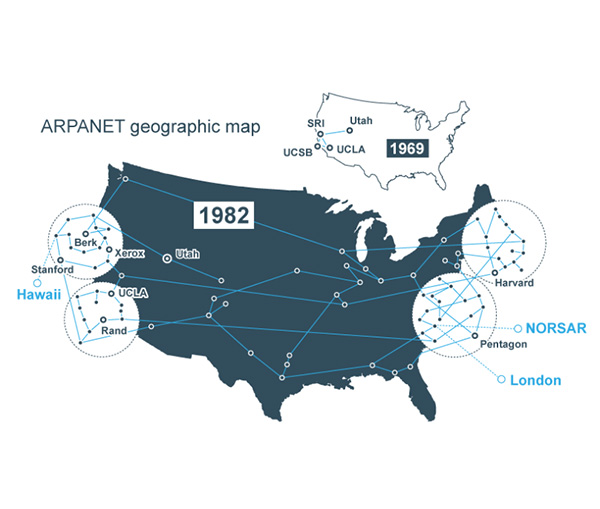
The launch of the Soviet satellite Sputnik (1957) during the Cold War triggered a U.S. push for technological innovation to ensure national security. The U.S. Department of Defense sought ways to share and safeguard information, even in the aftermath of a nuclear attack. This need for resilient communication led to the creation of
ARPANET in 1969.
ARPANET, funded by the Defense Advanced Research Projects Agency (DARPA), connected multiple computers into a single network. On October 29, 1969, the first message was sent between UCLA and Stanford Research Institute, but the system crashed after transmitting just two letters: “LO.”
Establishing Network Protocols
The 1970s were pivotal in refining how computers communicated. Robert Khan and Vinton Cerf developed the Transmission Control Protocol (TCP) and later TCP/IP, the protocols that standardised communication across different systems.
The era also saw innovations like email, invented by Ray Tomlinson in 1979. Tomlinson chose the now-iconic @ symbol to differentiate usernames from host addresses, revolutionizing personal and professional communication.

The Internet is Officially Born

On January 1, 1983, ARPANET officially adopted TCP/IP, marking the Internet’s “birth.” This transition enabled networks across the globe to connect seamlessly. The Domain Name System (DNS) was introduced to replace numeric IP addresses with user-friendly names like “.com,” “.org,” and “.edu.”
However, the Internet was still a tool for researchers and tech-savvy individuals, requiring advanced skills to operate.
The World Wide Web Revolution
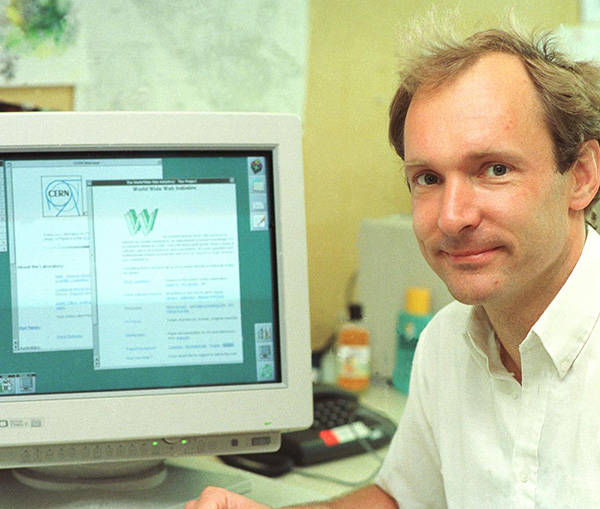
In 1989, British scientist Tim Berners-Lee proposed the World Wide Web, a system that used hyperlinks to connect documents on the Internet. The Web simplified access to information, making it possible for non-experts to use the Internet. Berners-Lee launched the first website, info.cern.ch, in 1991, introducing the world to web pages. His invention transformed the Internet from a niche tool into a globally accessible resource.
The First Browsers and Web Growth
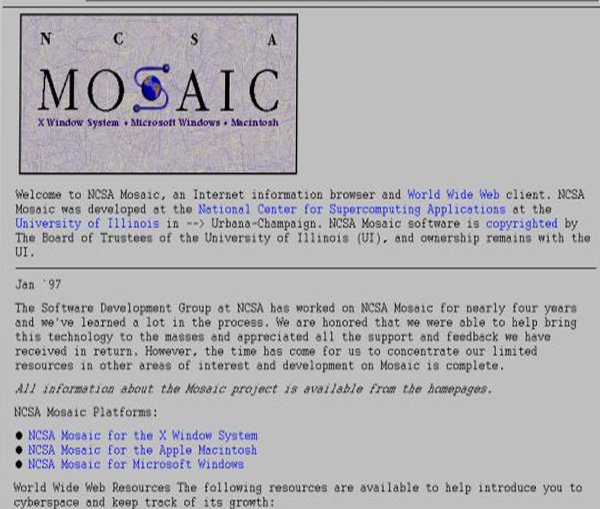
In 1993, the launch of the Mosaic web browser by Marc Andreessen made the Web visually appealing and easy to use, significantly boosting its popularity. Netscape Navigator emerged in 1994 as Mosaic’s competitor, further driving adoption.
During this period, the number of websites exploded:
1998: Google was launched, revolutionizing how information was searched and accessed.
1992: 10 websites.
1996: Over 100,000 websites.
The Dot-Com Bubble and Its Aftermath
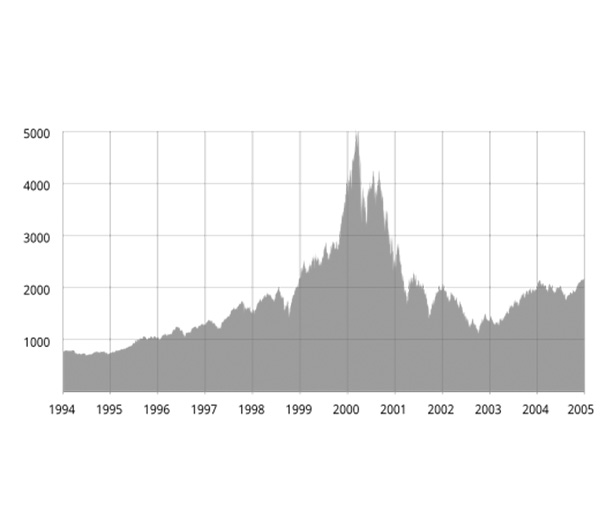
The late 1990s saw a massive speculative investment in Internet-related companies during the Dot-Com Bubble. Stock values of Internet startups soared without sustainable business models. By 2000, the bubble burst, causing widespread financial losses and bankruptcies.
Despite this setback, it paved the way for Web 2.0, characterized by user-generated content, interactive platforms, and the rise of social media.
The Rise of Social Media and Smartphones

Web 2.0 ushered in a new era of interactivity. Facebook (2004) connected users in a way never seen before, while YouTube (2005) became the go-to platform for video content. The release of the iPhone in 2007 marked the beginning of widespread mobile Internet use, allowing people to stay connected anywhere. By 2010, billions of users were engaging with the Internet daily, sharing, creating, and consuming content.
More about development of the internet:
 Nazar Tarnavskyi
Leave a comment